
OCD vs OCPD: Why The Confusion is So Common
Obsessive Compulsive Disorder (OCD), and Obsessive-Compulsive Personality Disorder, (OCPD), sound almost identical, but they are very different experiences.
Many people, especially young adults, overwhelmed parents of adolescents, and caretakers, mislabel themselves or loved ones as “having OCD” when what they’re noticing is perfectionism, rigidity, or control.
Understanding the difference matters, not for labels, but for compassion, clarity, and the right kind of support.
What Does OCD Look Like?
OCD is an anxiety-based disorder.
The core experience is unwanted intrusive thoughts, images, or urges that cause distress, followed by compulsions meant to reduce that anxiety.
People with OCD often think:
“What if something terrible happens?”
“What if I hurt someone?”
“What if I didn’t lock the door correctly?”
These thoughts are ego dystonic, meaning they feel foreign, upsetting, and not aligned with the person’s values.
Common OCD patterns include:
Repetitive checking, cleaning, counting, or mental rituals
Intense anxiety if rituals are not completed
Awareness that the behaviors are excessive, but feeling unable to stop
Significant distress and interference with daily life
OCD is not about liking control, it’s about being trapped by fear.
What Does OCPD Look Like?
OCPD is a personality pattern, not an anxiety disorder.
The core issue is rigidity, perfectionism, and control, often at the expense of relationships and emotional flexibility.
People with OCPD may:
Believe their way is the “right” or “moral” way
Struggle with delegation because others won’t do it correctly
Prioritize productivity over rest and relationships
Feel uncomfortable with spontaneity or emotional expression
These traits are ego syntonic, meaning they feel correct and justified to the person, even if others experience them as controlling or inflexible.
Unlike OCD, people with OCPD usually do not experience intrusive thoughts or rituals driven by fear. The behaviors feel purposeful and aligned with their identity.
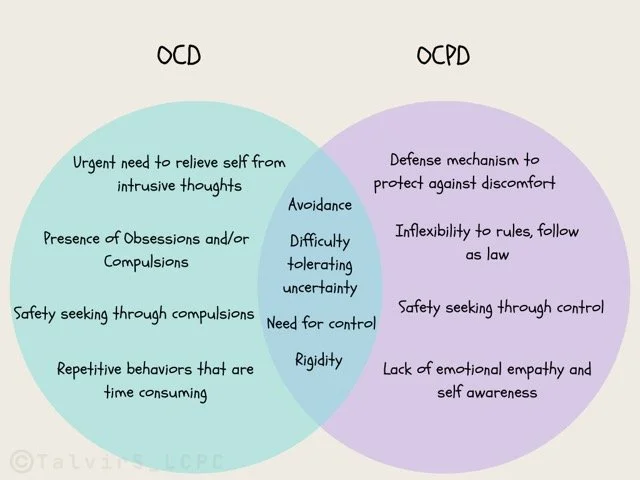
How to Differentiate OCD and OCPD:
Notice the Emotional Driver:
Is this behavior driven by fear and anxiety, or by rules and standards?
Does it feel distressing and unwanted, or necessary and “right”?
This distinction is often the clearest indicator between OCD and OCPD.
Look at Insight and Distress:
People with OCD often say, “I know this doesn’t make sense, but I can’t stop.” People with OCPD often say, “This is just how things should be done.”
Both experiences are valid, but they require different therapeutic approaches.
Pay Attention to Relationship Impact:
OCD tends to exhaust the person internally. OCPD tends to strain relationships externally.
If loved ones feel constantly corrected, managed, or emotionally shut out, OCPD traits may be present. If the person themselves feels tormented by their thoughts, OCD may be the issue.
Whether it’s OCD, OCPD, or a mix of traits, therapy can help unpack why control feels necessary and how to build flexibility without shame.
For OCD, evidence-based treatments focus on reducing anxiety and breaking the fear ritual cycle. For OCPD, therapy often explores identity, emotional expression, values, and relational patterns.
You don’t need to self-diagnose to deserve help!
At Herr-Era, we’re here to help! If control, perfectionism, or anxiety are running your life, therapy is not about taking control away, it’s about giving you more freedom.
If this resonates with you or someone you care for, reaching out to a mental health professional can be the first step toward relief, not failure.